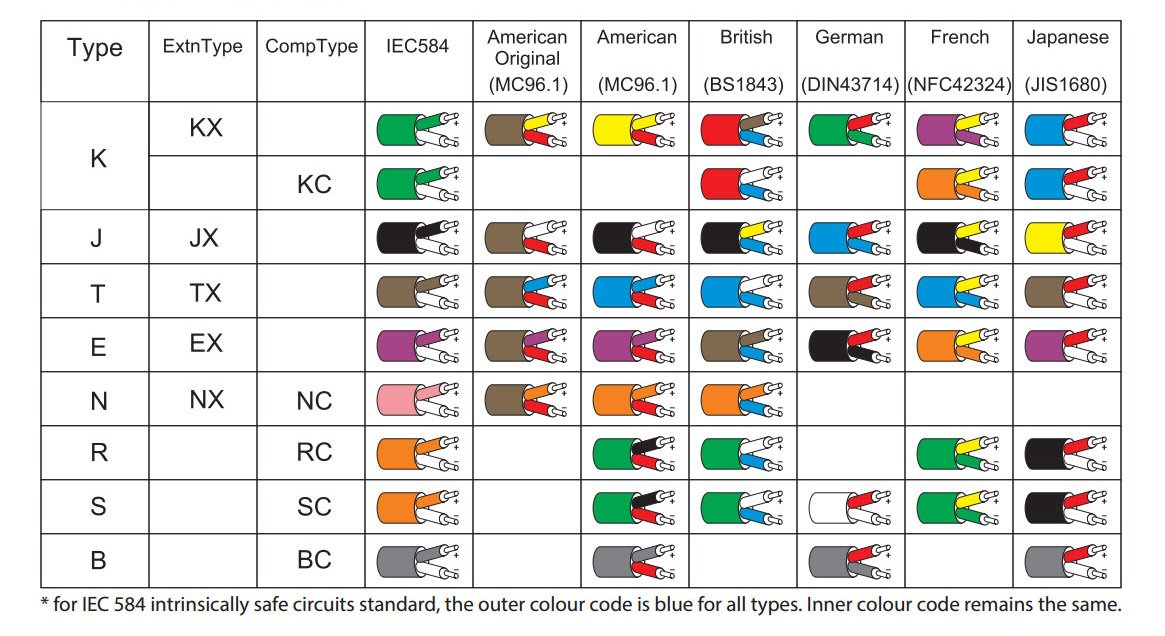
Thermocouple Color Code Chart – ANSI, IEC & International Standards
Use this thermocouple color code chart to identify the type and polarity of any thermocouple wire or cable. The chart covers Types K, J, T, E, N, R, S and B, and compares the ANSI (MC96.1 / ASTM E230), IEC 60584-3, British, German, French and Japanese colour standards side by side.
At Raystek, a thermocouple manufacturer in India, we make and supply thermocouples, thermocouple wires and extension cables for furnaces, ovens, kilns, boilers, process plants and laboratories. Our engineers wrote this guide to help you wire sensors correctly the first time, avoid polarity errors and order the right cable for your standard.
What Is a Thermocouple Color Code?
A thermocouple color code is a standard colour scheme for thermocouple wire insulation. Each type of thermocouple uses a specific pair of alloys, and the colours identify those alloys. The code shows three things:
- Thermocouple type: the jacket colour tells you whether the cable is K, J, T, E, N, R, S or B.
- Polarity: one coloured conductor is positive and the other is negative.
- Cable grade: the letter X marks extension grade and the letter C marks compensating grade.
Correct colour identification protects your temperature readings. A reversed or mismatched cable gives wrong values, and the error is often hard to trace after installation.
Thermocouple Color Code ANSI (MC96.1 / ASTM E230)
The American standard was originally published as ANSI MC96.1. The current reference for thermocouple colour coding in the USA is ANSI/ASTM E230. The key rule is simple: the red conductor is always negative.
| Type | Extension / Cable Type | Positive (+) | Negative (−) | Outer Jacket |
|---|---|---|---|---|
| K | KX | Yellow | Red | Yellow |
| J | JX | White | Red | Black |
| T | TX | Blue | Red | Blue |
| E | EX | Purple | Red | Purple |
| N | NX | Orange | Red | Orange |
| R / S | SX (compensating) | Black | Red | Green |
| B | BX (compensating) | Grey | Red | Grey |
Older installations may still use the American Original colour code (the earlier MC96.1 scheme), which used a brown jacket for several types. If you maintain an older plant, check the cable markings and the instrument manual before you replace any cable.
Thermocouple Color Code IEC (IEC 60584-3)
IEC 60584-3 (earlier numbered IEC 584-3) is the international standard. Most of Europe, the Middle East, Asia and many export markets follow it. The key rule is: the white conductor is always negative.
| Type | Extension / Compensating | Positive (+) | Negative (−) | Outer Sheath |
|---|---|---|---|---|
| K | KX / KC | Green | White | Green |
| J | JX | Black | White | Black |
| T | TX | Brown | White | Brown |
| E | EX | Violet | White | Violet |
| N | NX / NC | Pink | White | Pink |
| R | RC | Orange | White | Orange |
| S | SC | Orange | White | Orange |
| B | BC | Grey | White | Grey |
ANSI vs IEC Thermocouple Color Code – Key Differences
| Feature | ANSI (MC96.1 / E230) | IEC 60584-3 |
|---|---|---|
| Negative wire | Always red | Always white |
| Type K jacket | Yellow | Green |
| Type J positive wire | White | Black |
| Type T jacket | Blue | Brown |
| Type N jacket | Orange | Pink |
| Type R / S jacket | Green | Orange |
| Common regions | USA, Canada and plants built to US specifications | Europe, India, Middle East, Asia and most export projects |
The two codes use the same colour for some types and different colours for others. This is why mixed-standard installations cause the most polarity mistakes.
Thermocouple Color Code by Country
Several countries used national standards before IEC became the global reference. You may still find these cables in older plants and imported machinery. The table shows the positive wire, negative wire and sheath colour for each standard.
| Type | British (BS 1843) | German (DIN 43714) | French (NFC 42324) | Japanese (JIS C 1610, older) |
|---|---|---|---|---|
| K | Brown (+) / Blue (−), Red sheath | Red (+) / Green (−), Green sheath | Yellow (+) / Purple (−), Purple sheath | Red (+) / White (−), Blue sheath |
| J | Yellow (+) / Blue (−), Black sheath | Red (+) / Blue (−), Blue sheath | Yellow (+) / Black (−), Black sheath | Red (+) / White (−), Yellow sheath |
| T | White (+) / Blue (−), Blue sheath | Red (+) / Brown (−), Brown sheath | Yellow (+) / Blue (−), Blue sheath | Red (+) / White (−), Brown sheath |
| E | Brown (+) / Blue (−), Brown sheath | Red (+) / Black (−), Black sheath | Yellow (+) / Orange (−), Orange sheath | Red (+) / White (−), Purple sheath |
| N | Orange (+) / Blue (−), Orange sheath | Not listed | Not listed | Not listed |
| R | White (+) / Blue (−), Green sheath | Not listed | Yellow (+) / Green (−), Green sheath | Red (+) / White (−), Black sheath |
| S | White (+) / Blue (−), Green sheath | Red (+) / White (−), White sheath | Yellow (+) / Green (−), Green sheath | Red (+) / White (−), Black sheath |
| B | Not listed | Red (+) / Grey (−), Grey sheath | Not listed | Red (+) / White (−), Grey sheath |
Thermocouple Wire Color Code by Type
Type K Thermocouple Color Code
Type K (Nickel-Chromium / Nickel-Aluminium) is the most widely used thermocouple. ANSI: yellow (+), red (−), yellow jacket. IEC: green (+), white (−), green sheath. See our Type K thermocouples.
Type J Thermocouple Color Code
Type J (Iron / Constantan) suits general industrial heating. ANSI: white (+), red (−), black jacket. IEC: black (+), white (−), black sheath. See our Type J thermocouples.
Type T Thermocouple Color Code
Type T (Copper / Constantan) suits low-temperature and cryogenic work. ANSI: blue (+), red (−), blue jacket. IEC: brown (+), white (−), brown sheath. View our thermocouple range.
Type E Thermocouple Color Code
Type E (Nickel-Chromium / Constantan) gives high output per degree. ANSI: purple (+), red (−), purple jacket. IEC: violet (+), white (−), violet sheath. View our thermocouple range.
Type N Thermocouple Color Code
Type N (Nicrosil / Nisil) offers better high-temperature stability than Type K. ANSI: orange (+), red (−), orange jacket. IEC: pink (+), white (−), pink sheath. View our thermocouple range.
Type R, S and B Thermocouple Color Code
Platinum types use compensating cable. ANSI: R/S black (+), red (−), green jacket; B grey (+), red (−), grey jacket. IEC: R and S orange (+), white (−), orange sheath; B grey (+), white (−), grey sheath. See our Type R thermocouples.
Thermocouple Polarity: Which Wire Is Positive and Which Is Negative?
Many users search for “K type thermocouple wire color positive negative” or “J type thermocouple wire color red white”. Use this rule:
- Red conductor present? The cable is probably ANSI. Red is negative. The other wire is positive.
- White conductor present? Check the jacket colour. A white negative with a green, black or brown jacket points to IEC. White as the positive wire in a black-jacket cable is a Type J under ANSI.
- Still unsure? Use a magnet on Type J and Type K legs. In Type J, the iron (positive) leg is magnetic. In Type K, the nickel-aluminium (negative) leg is slightly magnetic. Then confirm with a measurement against a known sensor or the supplier’s datasheet.
Extension Cable (X) vs Compensating Cable (C)
The chart lists an extension type (KX, JX, TX, EX, NX) and a compensating type (KC, NC, RC, SC, BC). These two grades are not interchangeable. Raystek supplies both grades in our RTD and thermocouple cables range, with different cable insulation options for your temperature and environment.
- Extension cable (X): uses the same alloys as the thermocouple. It is used for base-metal types K, J, T, E and N.
- Compensating cable (C): uses different, lower-cost alloys with a matching thermoelectric output over a limited temperature range. It is used for platinum types R, S and B, and for some K and N applications.
How to Identify an Unknown Thermocouple Cable
- Read the printed markings on the jacket. Many cables carry the type and standard.
- Note the jacket colour and the colour of each insulated conductor.
- Match both against the ANSI and IEC tables above.
- Check for a magnetic leg to confirm Type J or Type K.
- If the cable is unmarked or the colours are faded, send a sample to our technical team for identification.
Common Thermocouple Wiring Mistakes to Avoid
- Mixing standards: connecting an IEC cable to an ANSI instrument input without checking polarity.
- Using the wrong grade: using a compensating cable on a base-metal thermocouple or the reverse.
- Using copper wire: extending a thermocouple with ordinary copper cable adds a second junction and an error.
- Mixing types: joining Type K and Type J cable in the same run.
- Poor connectors: using connectors made of a different alloy than the cable. Choose matching thermocouple connectors for your type and colour code.
Related Thermocouple Resources
- Thermocouple specifications: ranges, tolerances and construction details.
- Protection tube material guide: choose the right sheath for your process.
- RTD vs thermocouple: decide which sensor suits your application.
- Technical guide: selection and installation notes.
- Mineral insulated thermocouples, head mount thermocouples and ceramic thermocouples for high-temperature and industrial use.
- Thermowells: protect your sensor in pressurised and corrosive lines.
Thermocouple Color Code PDF Download
Download our thermocouple color code chart as a PDF for quick reference at your workshop, control panel or site. The PDF includes the ANSI, IEC, British, German, French and Japanese codes for all types.
You can also browse more technical documents on our downloads page.
Download the Raystek Thermocouple Color Code Chart (PDF)
Why Choose Raystek for Thermocouples and Cables?
Complete product range
We supply Type K, J, T, E, N, R, S and B thermocouples, including ceramic tube, bayonet and leaf type designs, plus connectors and cables.
ANSI and IEC options
We build cables and sensors to the colour code your market requires, so they match your instruments on day one.
Custom construction
Tell us the temperature range, sheath material, immersion length and process. Our engineers recommend the right type and configuration.
Made in India, shipped worldwide
We manufacture in India and supply OEMs, furnace builders, distributors and plants across India and export markets.
Frequently Asked Questions About Thermocouple Color Codes
What is a thermocouple colour code?
A thermocouple colour code is a standard system that assigns colours to the positive wire, the negative wire and the outer jacket of thermocouple cable. The colours tell you the thermocouple type (K, J, T, E, N, R, S or B) and the correct polarity, so you can connect the cable without errors.
What is the difference between the ANSI and IEC thermocouple colour codes?
The ANSI code (MC96.1, now part of ANSI/ASTM E230) always makes the negative wire red. The IEC 60584-3 code always makes the negative wire white. The jacket colours also differ: a Type K cable has a yellow jacket under ANSI and a green jacket under IEC.
What are the wire colours for a Type K thermocouple?
Under ANSI, Type K uses a yellow positive wire, a red negative wire and a yellow jacket. Under IEC 60584-3, it uses a green positive wire, a white negative wire and a green sheath.
What is the colour of the positive and negative wire in a Type J thermocouple?
Under ANSI, the positive wire is white and the negative wire is red, with a black jacket. Under IEC, the positive wire is black and the negative wire is white, with a black sheath. So a red-and-white J-type cable follows the American code.
Which wire is negative in a thermocouple?
Under ANSI, the red wire is always negative. Under IEC 60584-3, the white wire is always negative. Always confirm which standard your cable follows before you connect it.
What does X mean in KX, JX, TX, EX and NX?
The letter X marks an extension grade cable. It uses the same alloys as the thermocouple itself and carries the signal from the sensor to the instrument.
What is the difference between extension cable and compensating cable?
Extension cable (X) uses the same alloys as the thermocouple. Compensating cable (C) uses different, lower-cost alloys that match the thermocouple’s output over a limited temperature range. Platinum types R, S and B use compensating cable.
What colour is an intrinsically safe thermocouple cable?
Under the IEC 584 standard for intrinsically safe circuits, the outer sheath is blue for all types. The inner conductor colours stay the same as the standard code.
What happens if I connect a thermocouple with reversed polarity?
The instrument will show a wrong temperature. The reading may move down when the process heats up, or show an error value. Reconnect the cable with correct polarity and check it against the colour code.
Do Raystek thermocouple cables follow ANSI or IEC colour codes?
Raystek supplies thermocouple wires and cables to both ANSI and IEC colour codes. Tell us the standard and thermocouple type with your enquiry, and our team will confirm the correct construction.
Need Thermocouples or Thermocouple Cable?
Share your thermocouple type, colour standard (ANSI or IEC), temperature range and quantity. The Raystek team will send you a quotation and technical guidance.
Request a Quote View ThermocouplesPrefer to meet in person? Request a visit.
Phone: +91-9737581848 | Email: info@rayselectro.com
Related searches: R type thermocouple | Ceramic tube thermocouple | Thermocouple manufacturer in India | Thermocouple supplier in India | Bayonet thermocouple in Ahmedabad | Leaf type thermocouple | Thermocouple connector supplier